
How Physical Therapy Billing Services Improve Reimbursements
Physical therapy billing services help PT practices reduce claim errors, improve coding accuracy, manage denials, and receive payments faster. For physical therapists, billing can become challenging because each claim must be supported by proper documentation, accurate CPT codes, payer rules, authorization requirements, and medical necessity details.
When billing mistakes happen, payments may be delayed or denied. This can affect cash flow, increase administrative work, and take time away from patient care. A strong billing process helps physical therapy practices submit cleaner claims and follow up on reimbursements more efficiently.
For PT clinics, the goal is not just to send claims. The real goal is to submit accurate claims the first time, reduce denials, and keep the revenue cycle moving smoothly.
Why Physical Therapy Billing Can Be Challenging
Physical therapy billing is different from general medical billing because treatment often includes repeated visits, therapy plans, progress notes, procedure based coding, insurance limits, and payer specific rules. Many insurance plans have visit limits, authorization requirements, or documentation rules that must be followed before claims are paid.
PT billing also depends heavily on medical necessity. The payer needs to understand why therapy is needed, what condition is being treated, what services were provided, and how the patient is progressing. If the documentation does not support the service, the claim may be denied or delayed.
This is why physical therapy medical billing services need to focus on accuracy at every stage, from eligibility verification to coding, claim submission, payment posting, denial management, and A/R follow up.
Common Physical Therapy Billing Problems

Physical therapy claims are often denied because of preventable billing and documentation issues. Understanding these problems helps PT practices improve claim accuracy and reduce reimbursement delays.
Billing Problem |
Why It Happens |
How to Prevent It |
|---|---|---|
|
Eligibility issues |
Patient coverage, visit limits, or benefits are not verified before treatment |
Verify insurance before the first visit |
|
Missing prior authorization |
Approval was required but not obtained before services |
Check payer authorization rules before treatment starts |
|
Incorrect CPT codes |
Services are coded incorrectly or do not match documentation |
Use trained PT billing and coding specialists |
|
Modifier mistakes |
Required therapy modifiers are missing or incorrect |
Review payer specific modifier requirements |
|
Weak documentation |
Notes do not support medical necessity or treatment progress |
Keep complete therapy notes and progress records |
|
Timely filing issues |
Claims are submitted after the payer deadline |
Track payer filing limits and submit claims on time |
|
Denial follow up delays |
Denied claims are not corrected or appealed quickly |
Use a structured denial management process |
|
A/R aging |
Unpaid claims are not followed up consistently |
Review accounts receivable regularly |
How Physical Therapy Billing Services Improve Reimbursements
Physical therapy billing services improve reimbursements by creating a more accurate and organized billing workflow. Instead of only fixing denied claims after they happen, the goal is to prevent billing errors before claims are submitted.
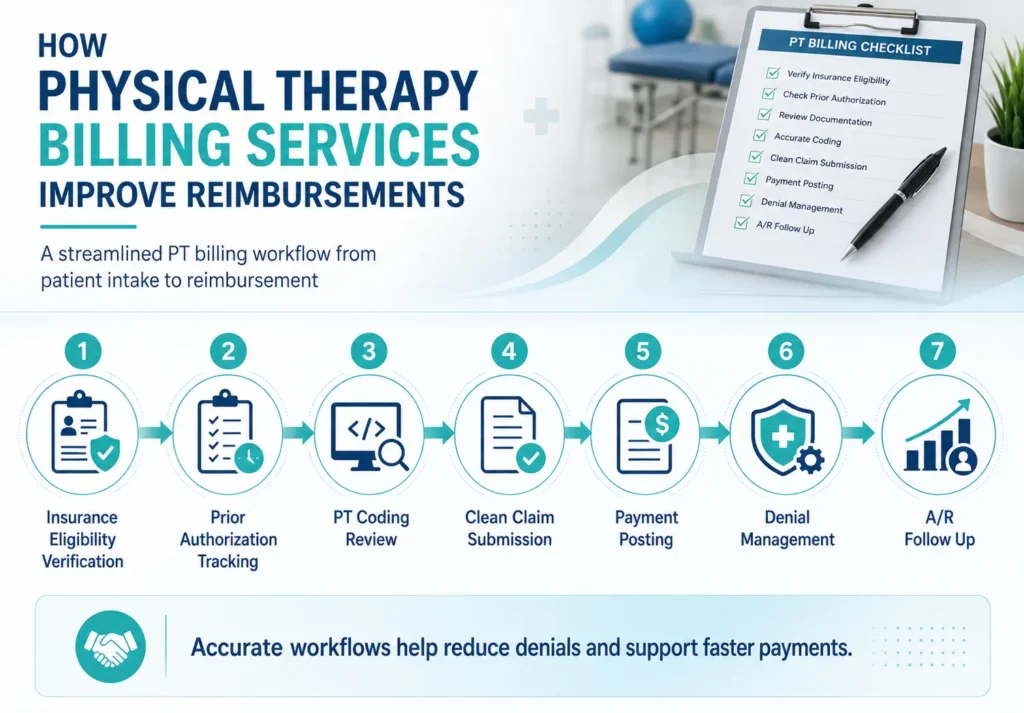
1. Insurance Eligibility Verification
Eligibility verification should be completed before the patient begins therapy. The billing team should confirm active coverage, therapy benefits, visit limits, copays, deductibles, referral needs, and prior authorization requirements.
This step helps PT practices avoid preventable denials and gives patients a clearer understanding of their coverage before treatment begins.
2. Prior Authorization Tracking
Many insurance plans require prior authorization for physical therapy services. If authorization is missed, the claim may be denied even when the therapy was medically necessary.
A strong PT billing process checks authorization requirements before treatment starts and tracks approved visits throughout the care plan. This helps prevent billing gaps when a patient continues therapy beyond the approved visit count.
3. Accurate Physical Therapy Billing and Coding
Physical therapy billing and coding requires careful review of services, documentation, CPT codes, modifiers, and payer rules. The claim should clearly match what was performed during the visit.
Accurate coding helps reduce denials and underpayments. It also helps the practice avoid billing inconsistencies that may trigger payer reviews or reimbursement delays.
4. Clean Claim Submission
A clean claim is complete, accurate, and ready for payer review. Before submission, the billing team should review patient details, provider information, insurance data, authorization status, procedure codes, diagnosis codes, modifiers, and documentation.
Clean claim submission improves the chance of faster payment and reduces the time staff spend correcting rejected or denied claims.
5. Payment Posting and Underpayment Review
Payment posting is more than recording payments. It helps the billing team confirm whether the payer paid correctly based on the allowed amount, contract terms, patient responsibility, and denial codes.
If a claim is underpaid, the billing team should identify the issue and follow up with the payer. This helps PT practices recover revenue that may otherwise be missed.
6. Denial Management
Denied claims should be reviewed quickly. A good denial management process identifies the denial reason, corrects the issue, submits appeals when needed, and tracks denial trends.
If the same denial happens repeatedly, the billing workflow should be updated. For example, repeated authorization denials may mean the front desk process needs improvement. Repeated coding denials may mean coding review needs to be stronger.
7. A/R Follow Up and Reporting
A/R follow up helps practices track unpaid claims and reduce aging accounts receivable. Without consistent follow up, claims may sit unpaid for weeks or months.
Physical therapy revenue cycle management should include regular reporting so practices can see denial trends, payment delays, underpayments, aging A/R, and overall billing performance.
Why Documentation Matters in Physical Therapy Billing
Documentation is one of the most important parts of physical therapy billing. It supports medical necessity and helps show why the service was needed.
For PT claims, documentation should clearly explain the patient’s condition, treatment plan, therapy goals, services provided, progress, and response to treatment. If the documentation is incomplete, the billing team may not have enough support to submit or defend the claim.
Documentation Area |
Why It Matters |
|---|---|
|
Patient diagnosis |
Supports the reason for therapy |
|
Treatment plan |
Shows what therapy services are needed |
|
Visit notes |
Supports services provided on each date |
|
Therapy goals |
Shows the expected outcome of care |
|
Progress notes |
Helps prove improvement or continued need |
|
Provider signature |
Completes the clinical record |
|
Medical necessity details |
Supports payer review and reimbursement |
Strong documentation helps reduce denials, support appeals, and improve reimbursement accuracy. It also helps physical therapy practices stay organized and audit ready.
Benefits of Outsourcing Physical Therapy Billing Services
Many PT practices manage billing in house, but internal teams can become overwhelmed with eligibility checks, authorization tracking, coding updates, payer calls, denial follow ups, payment posting, and patient billing questions.
Outsourcing physical therapy billing services can help reduce this workload and improve financial performance.
A professional billing partner can help with:
Outsourced physical therapy billing is especially helpful for practices facing frequent denials, delayed payments, coding problems, high A/R, or limited administrative staff. With the right billing support, PT clinics can improve claim accuracy, reduce billing stress, and focus more on patient care.
Final Thoughts
Physical therapy billing requires accuracy, consistency, and strong follow up. From eligibility verification and prior authorization to coding, documentation, claim submission, denial management, and A/R recovery, every step affects reimbursement.
Professional physical therapy billing services help PT practices reduce claim errors, prevent denials, improve coding accuracy, and strengthen revenue cycle performance.
If your physical therapy practice is dealing with delayed payments, denied claims, coding issues, or billing workload problems, Capital Med Solutions can help. Our team provides medical billing support designed to improve reimbursement accuracy and keep your revenue cycle moving.