How to Reduce Claim Denials in Gastroenterology Billing
For GI practices dealing with repeated denials, professional gastroenterology billing services can help improve claim accuracy, reduce reimbursement delays, and keep the revenue cycle moving smoothly. A strong billing process makes sure eligibility, prior authorization, coding, documentation, and claim submission are reviewed before claims are sent to payers.
Gastroenterology billing is more detailed than general medical billing because it often includes colonoscopy billing, endoscopy billing, pathology related documentation, prior authorization, modifiers, diagnosis codes, and payer specific rules. Even a small mistake in coding or documentation can lead to denied or delayed reimbursement.
For GI practices, the goal should not only be to fix denied claims. The real goal should be to prevent denials before the claim is submitted. This requires accurate eligibility verification, proper coding, complete documentation, clean claim submission, and consistent denial management.
Why Gastroenterology Billing Denials Happen
Gastroenterology billing denials happen when the payer finds an issue with the claim. This may be related to patient information, insurance eligibility, medical necessity, coding accuracy, missing prior authorization, or incomplete documentation.
GI billing can become complex because many procedures depend on the reason for the visit and what happens during the procedure. For example, a colonoscopy may be scheduled as a screening, but if a polyp is found and removed, the billing details may change. If the documentation and coding do not match the service performed, the claim may be denied.
Common Reasons GI Claims Get Denied
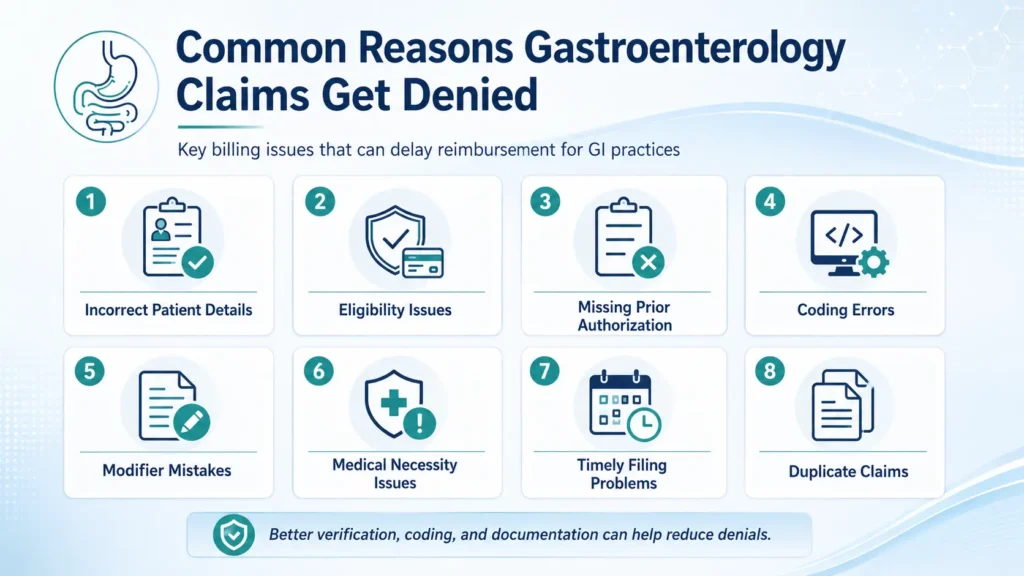
Gastroenterology claims can be denied for several preventable reasons, including eligibility issues, missing prior authorization, coding errors, modifier mistakes, and incomplete documentation. Understanding these common denial causes helps GI practices improve claim accuracy and reduce reimbursement delays.
A strong billing review process can help identify these problems before claims are submitted. When patient details, insurance coverage, procedure codes, diagnosis codes, modifiers, and documentation are checked properly, gastroenterology practices have a better chance of receiving timely and accurate reimbursement.
Denial Reason |
Why It Happens |
How to Prevent It |
|---|---|---|
|
Incorrect patient information |
Wrong name, date of birth, insurance ID, or policy details |
Verify patient demographics before the visit |
|
Eligibility issues |
Insurance is inactive or the service is not covered |
Check eligibility and benefits before the procedure |
|
Missing prior |
Approval was required but not obtained |
Confirm payer requirements before scheduling |
|
Coding errors |
CPT or ICD 10 codes do not match the service |
Use trained GI billing and coding specialists |
|
Modifier mistakes |
Required modifiers are missing or incorrect |
Review payer specific modifier rules |
|
Medical necessity denial |
Documentation does not support the procedure |
Improve clinical documentation |
|
Timely filing issues |
Claim was submitted after the payer deadline |
Track deadlines and submit claims quickly |
|
Duplicate claims |
The same claim was sent again without correction |
Check claim status before resubmission |
6 Ways Gastroenterology Billing Services Help Reduce Claim Denials
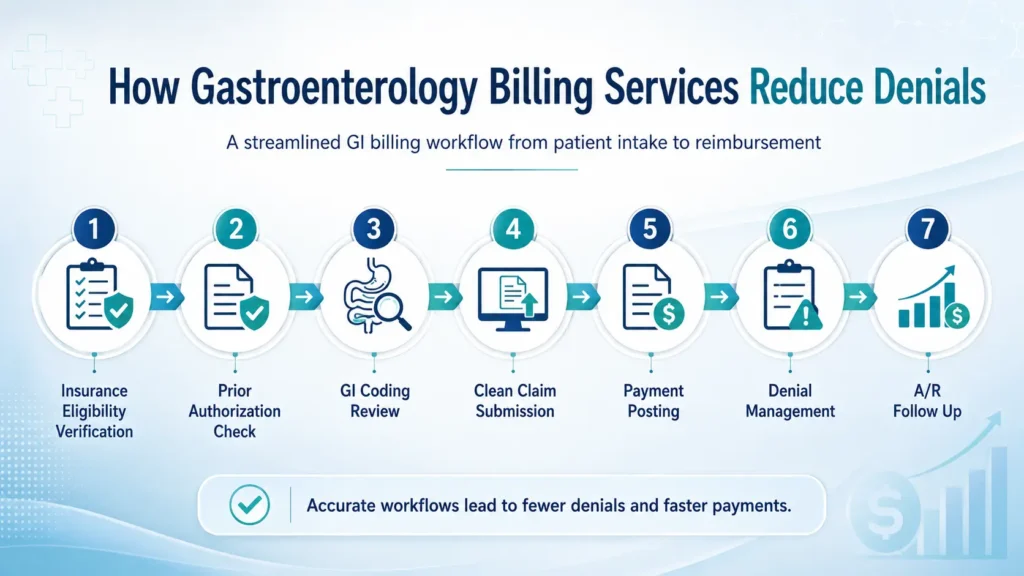
Gastroenterology billing services help GI practices reduce claim denials by improving every step of the billing workflow, from insurance verification to final payment follow up. When eligibility, prior authorization, coding, claim submission, and denial management are handled correctly, practices can avoid many preventable billing errors.
A structured GI billing process also helps improve claim accuracy, reduce reimbursement delays, and support better gastroenterology revenue cycle management. For gastroenterology practices, this is especially important because procedures like colonoscopy, endoscopy, and diagnostic GI services require accurate documentation, procedure coding, and payer specific billing review.
1. Verify Insurance Before the Visit
Eligibility verification should be completed before the patient’s appointment or procedure. The billing team should confirm that the insurance is active, the provider is in network, the service is covered, and any referral or prior authorization requirement is clear.
2. Check Prior Authorization Requirements
Many gastroenterology procedures may require prior authorization depending on the payer and plan. If authorization is missed, the claim may be denied even if the service was medically necessary.
Before scheduling procedures like colonoscopy, endoscopy, or other GI diagnostic services, the team should check payer rules and document the authorization status.
3. Use Accurate CPT and ICD 10 Codes
Gastroenterology medical billing and coding requires specialty knowledge. The codes must correctly represent the service performed and the reason for the procedure.
For example, screening, diagnostic, and therapeutic procedures may require different coding decisions. If the diagnosis code does not support the procedure code, the claim may be denied.
4. Review Modifiers Carefully
Modifiers help explain special billing situations. In GI billing, modifiers can affect how the payer processes the claim. Missing or incorrect modifiers can result in denials, underpayments, or patient billing issues.
A strong billing team should know which modifiers are needed for gastroenterology procedures and how payer rules may differ.
5. Submit Clean Claims the First Time
A clean claim is complete, accurate, and ready for payer review. Before submission, the billing team should check patient details, insurance information, provider details, authorization status, CPT codes, ICD 10 codes, modifiers, and documentation.
Submitting clean claims reduces delays and helps improve reimbursement speed.
6. Track Denial Patterns
Denial management should not only focus on fixing individual claims. It should also identify patterns.
If many claims are denied because of authorization issues, the front end process may need improvement. If denials are related to coding, the practice may need better coding review. If documentation is the problem, providers may need clearer templates or billing feedback.
Tracking denial trends helps the practice correct the root cause.
Why Documentation Matters in GI Billing
Documentation is one of the most important parts of gastroenterology billing. It connects the clinical service to the claim.
Good documentation should clearly explain:
Documentation Area |
Why It Matters |
|---|---|
|
Reason for visit |
Supports medical necessity |
|
Symptoms or screening history |
Helps select the right diagnosis code |
|
Procedure details |
Supports CPT code selection |
|
Findings during the procedure |
Helps show what was performed |
|
Treatment or intervention |
Supports diagnostic or therapeutic coding |
|
Follow up plan |
Completes the clinical record |
If the documentation is incomplete, the billing team may not have enough information to code the claim correctly. This can lead to denials, payment delays, or appeal issues.
How Outsourced Gastroenterology Billing Helps
Many GI practices struggle with denials because their internal staff are already busy with scheduling, patient communication, insurance calls, and daily office tasks. Outsourcing gastroenterology billing can help reduce this burden.
A professional gastroenterology billing company can help with:
For practices that are facing frequent denials, delayed payments, or growing A/R, outsourcing can improve billing accuracy and help the team focus more on patient care.
Capital Med Solutions provides gastroenterology billing services designed to help GI practices reduce denials, improve claim accuracy, manage reimbursements, and strengthen revenue cycle performance.
Final Thoughts
Reducing claim denials in gastroenterology billing requires a strong process from the first patient interaction to final payment. GI practices need accurate insurance verification, prior authorization checks, proper coding, complete documentation, clean claim submission, and regular denial tracking.
When these steps are handled correctly, practices can reduce payment delays, improve cash flow, and avoid repeated billing issues.
If your gastroenterology practice is dealing with denied claims, delayed reimbursements, or billing workflow problems, Capital Med Solutions can help you manage the process with expert gastroenterology billing support.