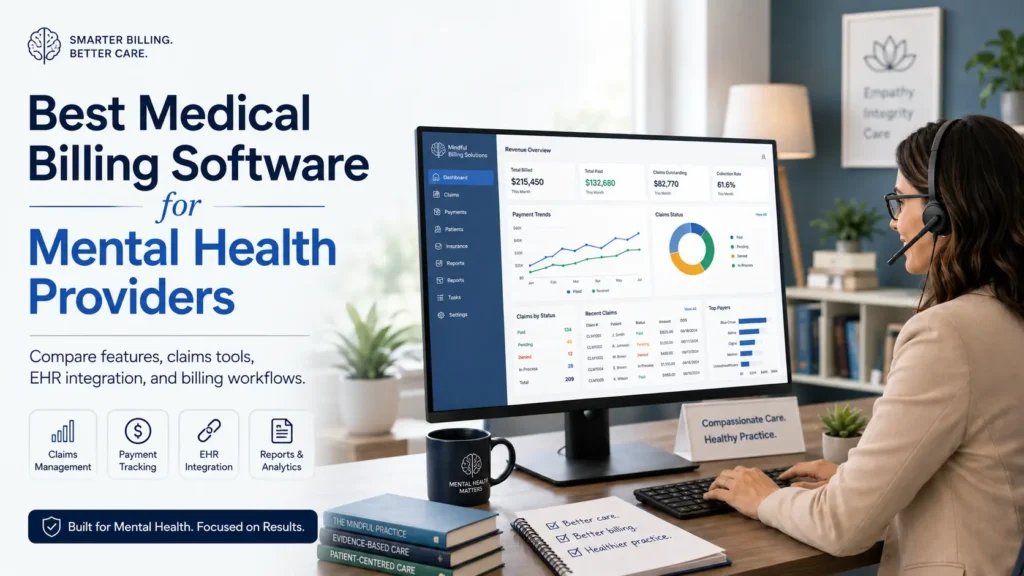
Best Medical Billing Software for Mental Health Providers
Choosing the best medical billing software for mental health providers is not just about sending claims faster. For therapists, counselors, psychiatrists, psychologists, and behavioral health clinics, the right software can make the difference between steady cash flow and constant billing stress.
Mental health billing services come with unique challenges. A provider may bill for individual therapy, group therapy, family therapy, psychiatric evaluations, medication management, telehealth visits, crisis services, or intensive outpatient care. Each service may require accurate CPT codes, diagnosis codes, modifiers, authorization tracking, payer-specific rules, documentation support, and timely follow-up.
That is why mental health providers need billing software built around behavioral health workflows, not just a generic tool made for any medical office.
In this guide, we will break down what to look for, which platforms are commonly used by mental health practices, and how to choose the best fit for your practice size, insurance model, budget, and revenue cycle needs.
Why Mental Health Providers Need Specialized Medical Billing Software
Mental health billing is different from many other specialties because reimbursement often depends on detailed documentation, session length, medical necessity, payer rules, and authorization requirements. A simple mistake in a modifier, diagnosis code, place of service, or provider credentialing detail can delay payment or lead to claim denials.
The need for better billing tools has also grown as more mental health professionals participate in insurance plans. CMS states that Marriage and Family Therapists and Mental Health Counselors have been able to bill Medicare independently for covered services beginning January 1, 2024. This makes billing accuracy even more important for practices that serve Medicare patients.
The best mental health billing software should help with:
Mental health practices also need to protect patient information. HHS explains that HIPAA rules apply to covered entities and business associates, which can include vendors that handle protected health information. Before choosing any billing software, providers should confirm whether the vendor offers the right privacy, security, and business associate agreement support.
What to Look for in Mental Health Billing Software
Before comparing platforms, it is important to know which features matter most. The best medical billing software for mental health providers should support both clinical and financial workflows.
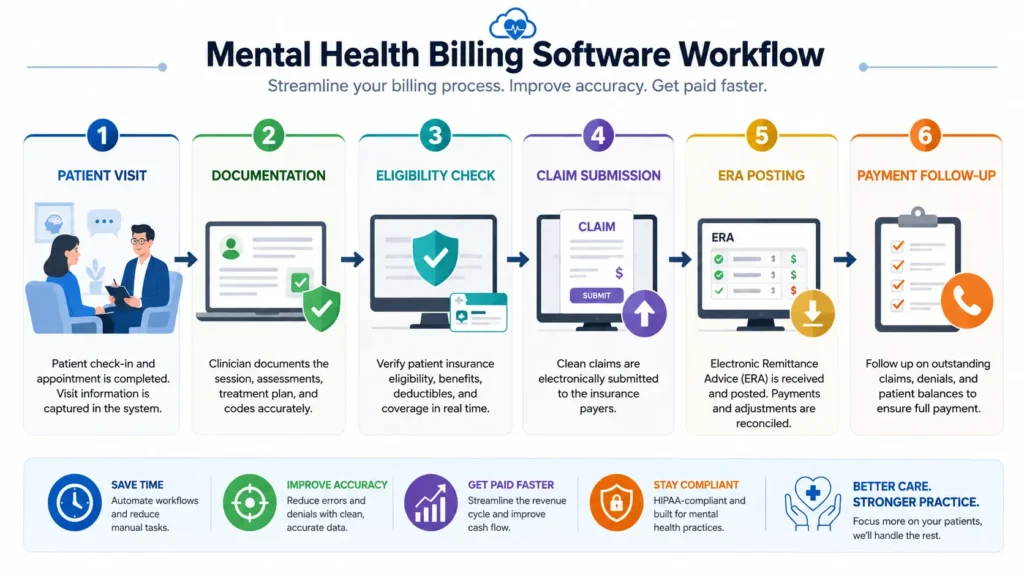
1. Electronic Claims Submission
Electronic claims submission is one of the most important features. Instead of printing paper claims or logging into multiple payer portals, your team should be able to create, review, scrub, and submit claims directly from the billing system.
Good claims software should allow you to:
For example, TherapyNotes states that its electronic billing tools allow providers to submit insurance claims and receive electronic remittance advice. Tebra also describes medical billing software as technology that helps practices manage claims, verify insurance, post ERA/EOB information, track payments, and flag denials.
2. Eligibility Verification
Eligibility verification helps confirm whether the patient’s insurance is active before the appointment. This can reduce front-desk confusion, surprise bills, and denied claims.
For mental health practices, eligibility checks are especially important because coverage may vary by:
A good billing system should make it easy to verify benefits before the visit and document the details inside the patient account.
3. Behavioral Health EHR Integration
Many mental health providers prefer an all-in-one EHR and billing system. This can help connect clinical notes, diagnosis codes, service codes, and claims in one workflow.
For example, ICANotes says its behavioral health billing software includes eligibility checks, electronic claim submission, auto-posting, denial management, and billing workflows integrated with the EHR. This type of integration can help reduce duplicate work between clinical documentation and billing.
4. ERA Posting and Payment Tracking
Electronic Remittance Advice, often called ERA, helps explain how a payer processed a claim. A strong billing platform should help post payments, adjustments, contractual write-offs, and patient balances with less manual work.
This is important because mental health practices often deal with ongoing weekly or biweekly visits. Without organized payment posting, balances can become confusing quickly.
5. Denial Management
Denied claims are one of the biggest revenue problems for mental health providers. Common reasons include:
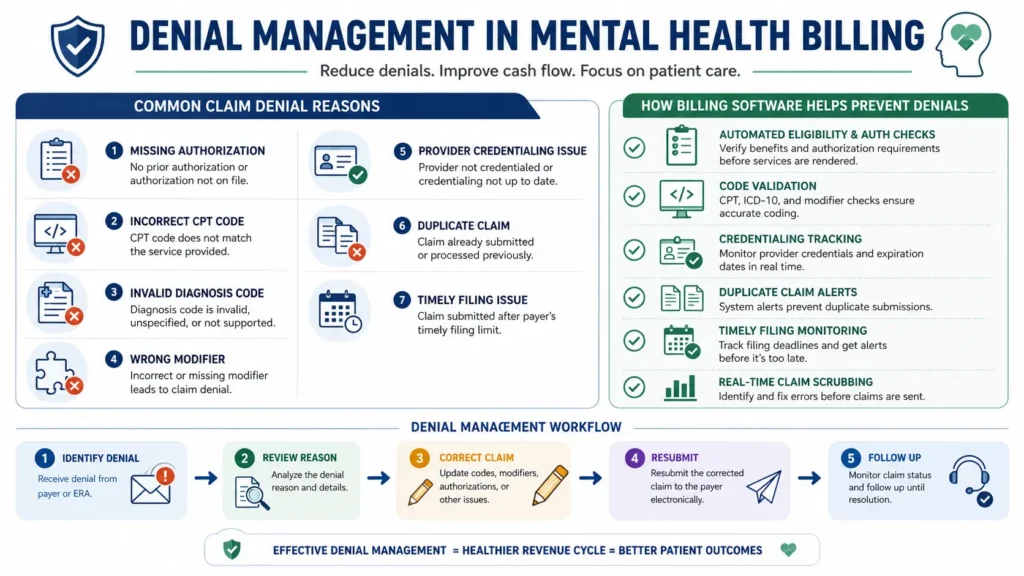
The best behavioral health billing software should help identify denial patterns and make follow-up easier.
6. Patient Billing and Payment Tools
Mental health practices often collect copays, deductibles, self-pay fees, late cancellation fees, and outstanding balances. Billing software should support easy patient invoicing and payment collection.
Look for:
SimplePractice, for example, describes tools for private practice insurance billing, automated superbill creation, claim batching, status tracking, and integrated ERAs.
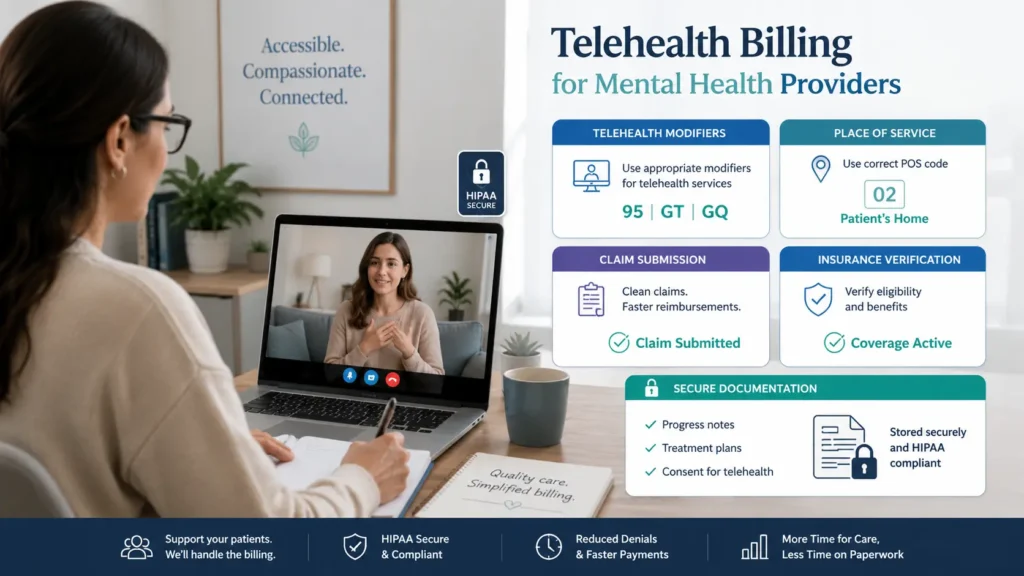
7. Telehealth Billing Support
Telehealth is a major part of mental health care in the United States. HHS notes that Medicare patients can permanently receive behavioral and mental health telehealth services in the home, with no geographic restrictions for Medicare behavioral/mental telehealth originating sites.
Because telehealth rules can vary by payer, your software should support:
8. Reporting and Revenue Cycle Visibility
Good billing software should show more than whether claims were submitted. Practice owners need visibility into financial performance.
Useful reports include:
Valant highlights billing reports that help practices track payments, monitor A/R, manage patient balances, and compare provider productivity.
Best Medical Billing Software for Mental Health Providers Top Options
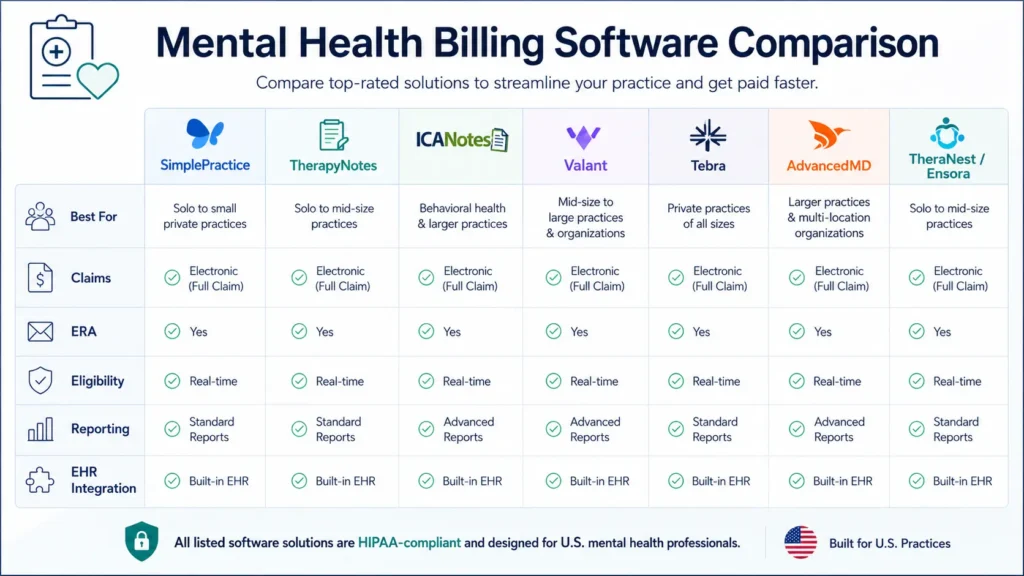
There is no single best software for every mental health practice. The right choice depends on your practice size, payer mix, clinical workflow, and billing needs.
Below are commonly used platforms for mental health and behavioral health billing.
SimplePractice
Best For Solo therapists and small private practices
SimplePractice is a popular option for solo and small private practices that want scheduling, documentation, telehealth, client communication, and billing in one system.
It is often a good fit for therapists, counselors, psychologists, and wellness providers who want a clean, user-friendly platform with private-pay and insurance billing tools.
Key Billing Features
SimplePractice states that its insurance billing tools include easy enrollments, automated claims, status tracking, integrated ERAs, and superbills.
Pros
Possible Limitations
Best Fit
SimplePractice is a strong choice for solo therapists, small counseling practices, and providers who want simple therapy billing software without a steep learning curve.
TherapyNotes
TherapyNotes is widely used by behavioral health providers and is known for mental health EHR, scheduling, notes, and billing tools.
It can be a strong option for practices that rely heavily on insurance reimbursement and want an organized billing workflow.
Key Billing Features
TherapyNotes says providers can submit claims electronically, track claims from submission through payment posting, and avoid third-party system logins for that workflow.
Pros
Possible Limitations
Best Fit
TherapyNotes is a good fit for therapists, psychologists, and behavioral health groups that bill insurance regularly and want a platform focused on mental health workflows.
ICANotes
Best For Behavioral health documentation plus billing
ICANotes is designed specifically for mental health and behavioral health providers. It is especially useful for practices that want documentation and billing connected closely.
This can matter for psychiatry practices, therapy groups, substance use treatment programs, and multidisciplinary behavioral health teams.
Key Billing Features
ICANotes describes its platform as behavioral health billing software that supports automatic coding, eligibility checks, and denial management.
Pros
Possible Limitations
Valant
Best For Growing behavioral health groups
Valant is designed for behavioral health practices and may be a good fit for growing clinics that need deeper reporting, practice management, and revenue cycle support.
It can be useful for practices with multiple providers, more complex billing operations, or a need for stronger financial visibility.
Key Billing Features
Valant states that it offers billing reports to track payments, monitor accounts receivable, manage patient balances, and compare provider productivity. Valant also describes revenue cycle management services for behavioral health practices that want dedicated RCM support.
Pros
Possible Limitations
Best Fit
Valant is a strong option for behavioral health groups that need more than basic claims submission and want better visibility into revenue performance.
Tebra
Best For Independent practices needing strong billing and practice management
Tebra, formerly connected with Kareo and PatientPop, offers EHR, billing, scheduling, patient communication, and practice growth tools. It can be a good fit for independent medical and behavioral health practices that want broader practice management support.
Key Billing Features
Tebra describes its platform as connecting care, billing, scheduling, and more. Its billing software page also explains that medical billing software helps manage claims, verify insurance, post ERA/EOBs, track payments, and flag denials.
Pros
Possible Limitations
Best Fit
Tebra may work well for independent practices that want billing, scheduling, EHR, patient communication, and growth tools in one broader platform.
AdvancedMD
Best For Larger or Multi-Provider Practices Needing Advanced Billing Tools
AdvancedMD is a robust EHR, practice management, patient engagement, and medical billing platform. It may be a good option for behavioral health groups that need more advanced reporting and administrative workflows.
Key Billing Features
AdvancedMD says its billing suite includes dashboards and worklists that help staff see outstanding claims, aging, denials, and follow-up tasks. AdvancedMD also has behavioral health software resources for independent and small-to-medium group practices.
Pros
Possible Limitations
Best Fit
AdvancedMD is a good option for larger mental health groups or practices with more complex billing, reporting, and operational needs.
TheraNest / Ensora Health
Best For Therapy practices needing EHR and practice management tools
TheraNest, now part of Ensora Health, is designed for mental health practices and includes tools for practice management, scheduling, documentation, and billing support.
Ensora Health describes TheraNest as a mental health EHR and practice management solution built to help practices save time, reduce administrative work, and run a successful practice.
Key Billing Features
Pros
Possible Limitations
Best Fit
TheraNest may be a good fit for small therapy practices that want a mental health EHR with practical billing and practice management tools.
Quick Comparison Table
|
Software |
Best For |
Strongest Billing Use Case |
|
Simple |
Solo and small therapy practices |
Easy claims, superbills, client billing |
|
TherapyNotes |
Insurance-heavy practices |
Electronic claims and ERA workflow |
|
ICANotes |
Behavioral health documentation-heavy practices |
EHR-connected billing and denial management |
|
Valant |
Growing behavioral health groups |
A/R tracking, reporting, RCM support |
|
Tebra |
Independent practices |
Claims, eligibility, payments, broader PM tools |
|
AdvancedMD |
Larger multi-provider practices |
Dashboards, A/R, denial worklists |
|
TheraNest / Ensora |
Therapy practices |
EHR, scheduling, billing, client portal |
How to Choose the Best Medical Billing Software for Your Mental Health Practice
The best software is the one that fits your real workflow. Before signing up, answer these questions.
Are You Private Pay, Insurance-Based, or Hybrid?
A private-pay therapy practice may only need invoices, superbills, online payments, and client statements. An insurance-heavy behavioral health practice needs stronger eligibility, claims, ERA posting, denial tracking, and payer reporting.
If you are hybrid, choose software that handles both insurance and self-pay billing cleanly.
How Many Providers Are in Your Practice?
A solo therapist usually needs simplicity. A group practice needs provider-level reporting, role-based access, scheduling controls, and revenue tracking by clinician.
For larger practices, reporting becomes more important because owners need to understand collections, productivity, A/R, denial rates, and payer performance.
Do You Need Built-In EHR Features?
If you want one system for notes, treatment plans, scheduling, telehealth, and billing, choose an integrated mental health EHR billing platform.
If you already love your EHR, you may need billing software or an RCM partner that works with your current system.
How Complex Is Your Insurance Billing?
Some mental health practices bill only a few common therapy codes. Others bill psychiatric evaluations, medication management, group therapy, family therapy, IOP, PHP, substance use treatment, or crisis services.
The more complex your services are, the more important it is to choose behavioral health billing software with strong payer rules, authorization tracking, reporting, and denial management.
Does the Software Support HIPAA Requirements?
Because billing software may handle protected health information, HIPAA support is essential. Confirm the vendor’s security practices, access controls, audit logs, encryption practices, and business associate agreement availability.
HHS explains that a business associate is a person or entity that performs certain functions involving protected health information on behalf of a covered entity.
Can Your Team Actually Use It?
The best software is not always the one with the longest feature list. If your front desk, biller, and providers struggle to use it, claims will still be delayed.
During a demo, test:
Common Mistakes to Avoid When Choosing Billing Software
Choosing Software Based Only on Price
Low monthly pricing can look attractive, but poor billing workflows may cost more in denied claims, missed payments, and staff time.
Ignoring Denial Management
Submitting claims is only the first step. Your software should help you follow up when claims are rejected, denied, underpaid, or delayed.
Not Checking Payer Compatibility
Before choosing software, confirm that the platform supports your main payers, clearinghouse needs, enrollment process, and claim formats.
Forgetting About Telehealth Billing
Mental health providers often rely on telehealth. Make sure your billing software supports telehealth modifiers, place-of-service requirements, and payer documentation needs.
Skipping the Demo
Never choose billing software without seeing the workflow. A demo helps you understand whether the system is easy enough for daily use.
Final Recommendation: What Is the Best Medical Billing Software for Mental Health Providers?
The best medical billing software for mental health providers depends on your practice model.
For solo therapists and small practices, SimplePractice or TherapyNotes may be strong options because they combine usability with mental health billing tools. For practices with detailed behavioral health documentation needs, ICANotes may be a strong fit. For growing groups that need better reporting and revenue cycle visibility, Valant or AdvancedMD may be worth considering. For independent practices that want broader practice management and billing tools, Tebra may be a good option.
The most important step is to match the software to your billing workflow, payer mix, practice size, documentation needs, and growth plans.
A good platform should help you submit cleaner claims, reduce manual work, track payments, manage denials, collect patient balances, and keep your revenue cycle organized.
FAQs About Medical Billing Software for Mental Health Providers
Conclusion
Choosing the best medical billing software for mental health providers is one of the most important decisions for your practice’s financial health. The right system can help you submit cleaner claims, collect payments faster, reduce billing stress, and give you a clearer view of your revenue cycle.
Before making a decision, compare features, request demos, check payer compatibility, review HIPAA-related safeguards, and make sure the software fits your daily workflow.
If your mental health practice is struggling with denied claims, unpaid patient balances, slow reimbursements, or confusing billing workflows, it may be time to upgrade your billing system or work with a professional medical billing team that understands behavioral health revenue cycle management.
Need Help Managing Mental Health Billing
Need help managing mental health billing, claim denials, or insurance reimbursements? Contact a trusted medical billing specialist to review your current workflow and improve your revenue cycle performance.