How EMR Software Benefits Orthopedic Practices
Orthopedic practices manage much more than routine patient notes. Providers must document musculoskeletal examinations, review diagnostic images, plan surgeries, track rehabilitation, manage durable medical equipment, and submit claims for complex procedures.
Handling these responsibilities through disconnected systems or general documentation tools can create delays, duplicate work, incomplete records, and billing problems.
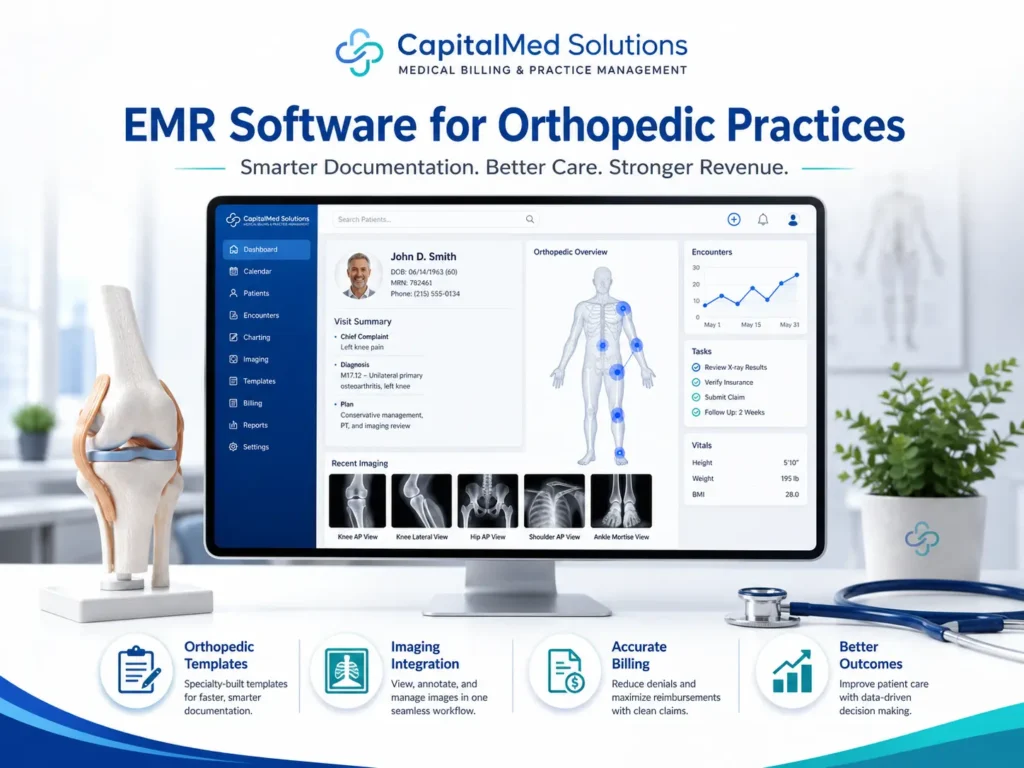
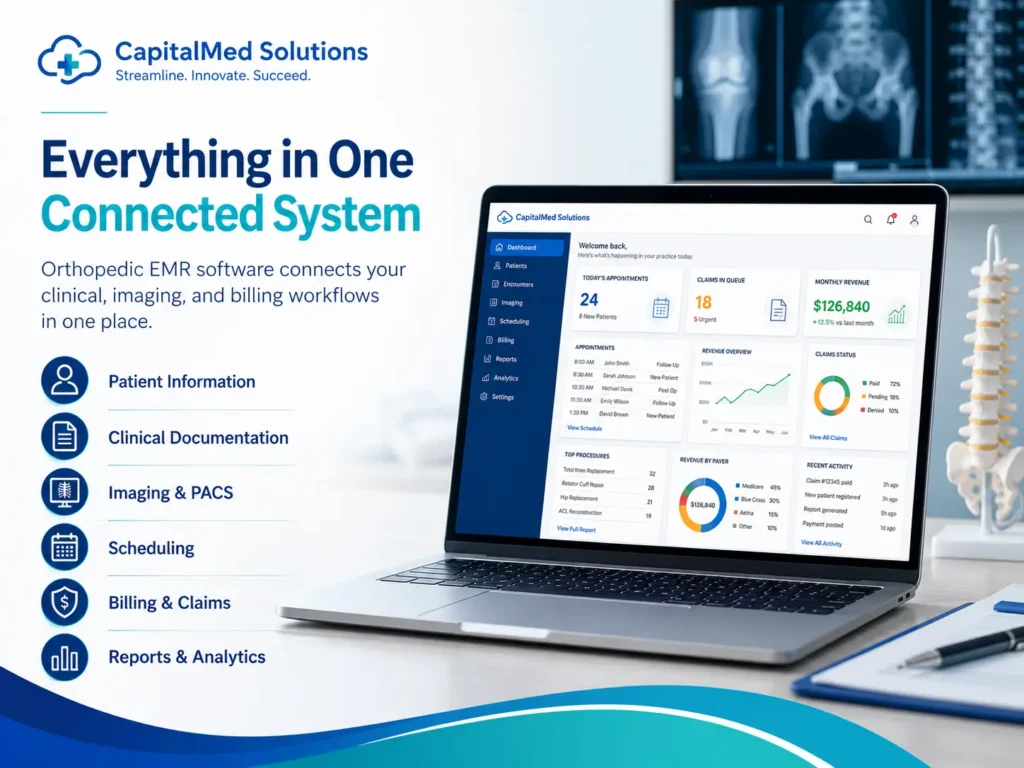
EMR software for orthopedic practices brings clinical, administrative, and financial information into one connected system. A well-configured platform can help orthopedic surgeons document visits faster, access imaging results, coordinate treatment, communicate with patients, and support more accurate billing.
Electronic records can also improve access to patient information, reduce duplicate testing, increase the clarity of medical records, and support better coordination between authorized healthcare providers.
What Is EMR Software for Orthopedic Practices?
Orthopedic EMR software is a digital system used to document, organize, retrieve, and manage patient information related to bone, joint, muscle, ligament, tendon, and spine care.
People frequently use the terms EMR and EHR interchangeably. An electronic medical record generally focuses on the patient’s history within one practice, while an electronic health record is designed to support broader information sharing across authorized healthcare organizations.
A specialty-focused orthopedic system may include:
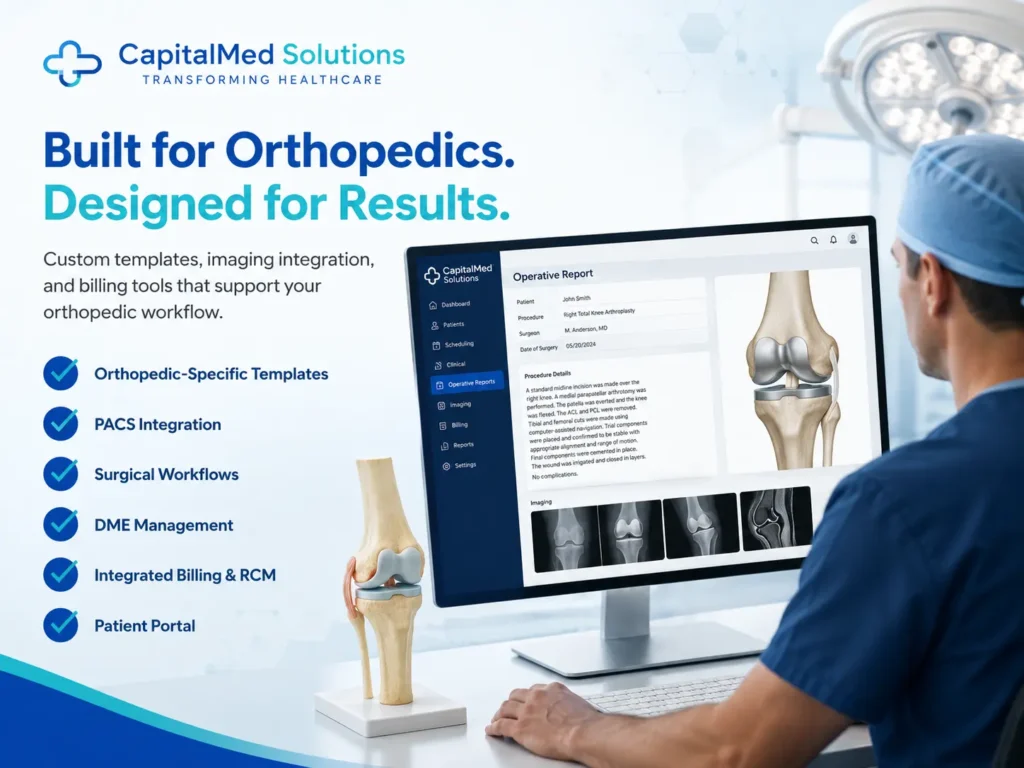
These features help the software follow an orthopedic practice’s actual workflow instead of forcing providers to use templates designed for general medicine.
Why Orthopedic Practices Need Specialized EMR Software
Orthopedic visits often involve detailed findings that vary by body part, injury type, treatment stage, and surgical history. A shoulder evaluation does not follow the same workflow as a knee replacement follow-up, spinal consultation, or fracture-care visit.
Generic EMR templates may require excessive clicking, manual typing, or repeated customization. Orthopedic-specific templates allow providers to document laterality, pain level, range of motion, stability, strength, imaging findings, treatment recommendations, and follow-up plans more efficiently.
This structured information can also support medical necessity, prior authorization, claim submission, and communication with physical therapists, imaging facilities, hospitals, and referring providers.
Faster Orthopedic Documentation
Documentation is one of the most important benefits of orthopedic EMR software.
Specialty templates can help physicians record common findings without rebuilding each note from the beginning. Providers may use customizable templates for conditions such as:
Voice recognition, mobile charting, saved preferences, and automated note population can further reduce repetitive data entry.
More complete documentation does not only save time. It can also support clinical decisions, coding accuracy, payer reviews, and continuity of care. Federal health IT guidance identifies improved documentation and automated coding capabilities as potential efficiency benefits of electronic records.
Better Access to Medical Images
Orthopedic providers regularly rely on X-rays, MRI scans, CT scans, ultrasound images, and previous surgical studies.
An orthopedic EMR that integrates with a picture archiving and communication system, or PACS, can allow providers to access images directly from the patient’s chart. This reduces the need to switch between platforms or search for separate imaging records.
Centralized imaging access can help the care team:
This is particularly valuable for multi-location orthopedic groups, surgical practices, and clinics working with outside imaging centers.
Improved Care Coordination
Orthopedic treatment may involve surgeons, primary care providers, radiologists, physical therapists, pain specialists, hospitals, and rehabilitation facilities.
An integrated orthopedic EHR system can organize information from these different stages of care. Authorized team members can review updated treatment plans, medications, test results, surgical notes, rehabilitation progress, and follow-up instructions.
Better access to complete patient information can reduce fragmented care and help providers make more informed decisions. Electronic records can also support alerts and follow-up workflows when a patient receives care from another organization.
More Accurate Orthopedic Billing and Coding
Orthopedic billing requires detailed documentation and precise code selection. Claims may involve fracture care, arthroscopy, joint injections, surgical assistance, durable medical equipment, multiple procedures, postoperative visits, and global surgical packages.
A connected EMR and billing system can transfer documented services into the billing workflow, reducing manual entry and missing information. It may also alert staff when required details are incomplete.
Useful billing-related features include:
CapitalMed Solutions’ orthopedic billing team works with platforms such as Kareo, Athenahealth, AdvancedMD, eClinicalWorks, Office Ally, CureMD, PrognoCIS, and SimplePractice.
Easier Prior Authorization Management
Orthopedic practices frequently need authorization for imaging, surgery, injections, physical therapy, medications, and durable medical equipment. Missing clinical information can lead to additional payer requests, delayed treatment, or denied authorization.
Orthopedic EMR software can help organize the records needed to support a request, including:
The system may also help staff track pending requests, payer responses, expiration dates, and required follow-ups.
Because authorization requirements differ by payer and procedure, the practice should still use trained staff to review every submission instead of relying entirely on software automation.
Better Patient Communication
A connected patient portal gives orthopedic patients a secure place to review information and communicate with the practice.
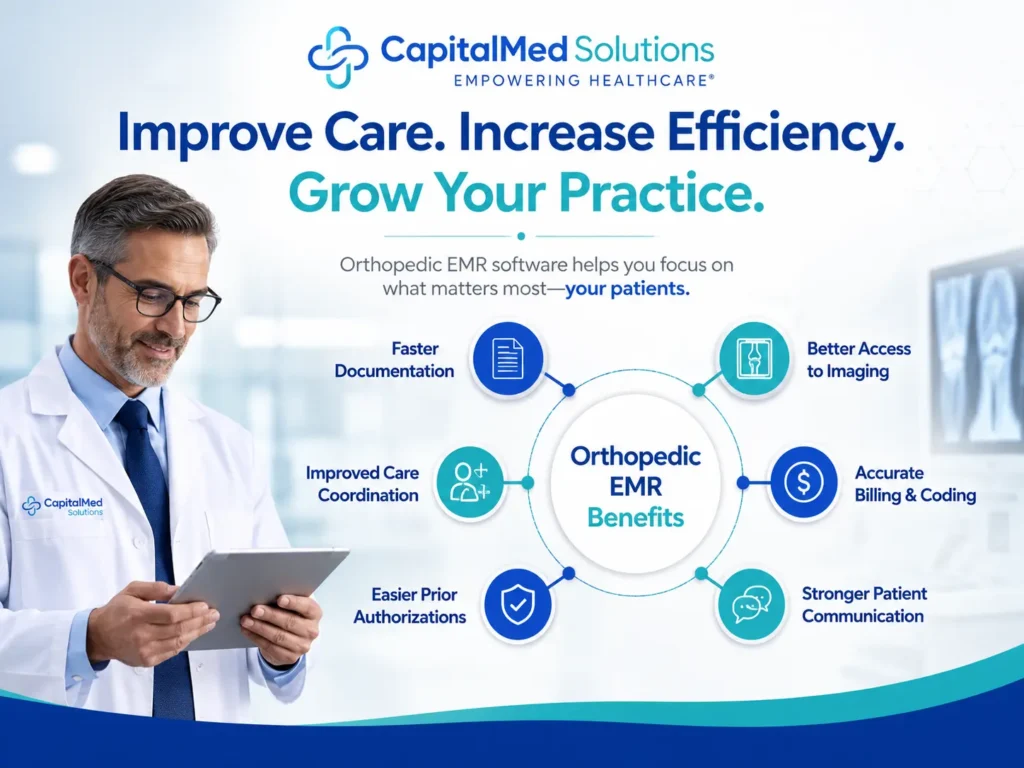
Depending on the system, patients may be able to:
Digital access is particularly helpful when patients must follow detailed instructions before surgery or during recovery. It can also reduce routine phone calls and allow staff to focus on more complex patient needs.
Orthopedic EMR vs General EMR
A general EMR may support basic scheduling, charting, prescribing, and billing. However, an orthopedic-specific system is usually better prepared for musculoskeletal documentation and procedure-based workflows.
|
Feature |
Orthopedic-Specific EMR |
General EMR |
|
Clinical templates |
Templates for joints, fractures, spine, sports injuries, and surgery |
Broad templates for common medical visits |
|
Body records |
Body-part diagrams, laterality, strength, and range-of-motion fields |
Limited musculoskeletal detail |
|
Imaging |
Often designed for PACS and diagnostic imaging integration |
Integration may require customization |
|
Surgical |
Preoperative, operative, and postoperative documentation |
Basic referral and procedure tracking |
|
Orthopedic coding |
Support for specialty procedures, modifiers, and charge capture |
General coding tools |
|
DME Handling |
May support braces, splints, and other orthopedic equipment |
Often limited or unavailable |
|
Outcome tracking |
Can track pain, mobility, recovery, and patient-reported outcomes |
General quality reporting |
|
Requirements |
Built around orthopedic workflows |
Requires greater template customization |
A general platform may still work for a smaller clinic, but the practice should calculate the time and cost required to customize it. The best option is the system that supports the practice’s clinical workflow, integrations, reporting needs, budget, and growth plans.
Features to Look for in Orthopedic EMR Software
Orthopedic practices: should evaluate the complete workflow rather than choosing software based only on price or brand recognition.
PACS and imaging integration: Providers should be able to retrieve and review diagnostic images without unnecessary steps.
Customizable documentation: Surgeons and providers should be able to adjust templates to match their documentation preferences.
Integrated billing: Clinical records, charge entry, coding, claims, and payment data should move through a connected workflow.
Prior authorization tracking: Staff should be able to manage requests for imaging, procedures, medications, and equipment.
Interoperability: The system should exchange structured information with authorized hospitals, laboratories, pharmacies, and other providers.
Patient portal: Patients should have secure access to forms, instructions, results, messages, and payment options.
Reporting tools: The practice should be able to monitor appointments, procedure volume, denials, collections, outcomes, and provider productivity.
Security controls: Access permissions, audit logs, secure backups, authentication, and staff training should be part of the security plan.
The HIPAA Security Rule requires appropriate administrative, physical, and technical safeguards for electronic protected health information. Using cloud-based software does not remove the practice’s responsibility to evaluate security risks and vendor compliance.
How EMR Supports Orthopedic Revenue Cycle Management
An orthopedic EMR becomes more valuable when it connects clinical documentation with the full revenue cycle.
For example, eligibility information can be verified before the appointment, documentation can support code selection, charges can be captured after the visit, and claims can be reviewed before submission.
The same system can then help staff track:
This information gives practice leaders a clearer view of where revenue is delayed or lost.
Why EMR Software Alone Is Not Enough
EMR software provides tools, but it does not automatically create accurate documentation, compliant coding, or successful reimbursement.
Results still depend on:
Templates that are too broad may produce incomplete notes. Templates that are too long may slow providers down. Automated code suggestions can also be incorrect when the clinical record does not support the recommended service.
For this reason, technology should support trained orthopedic billing, coding, and clinical teams rather than replace professional review.
How CapitalMed Solutions Supports Orthopedic Practices
CapitalMed Solutions helps orthopedic practices connect their technology with accurate billing and revenue cycle processes.
Our orthopedic billing support can include:
Our team understands the documentation and billing challenges connected with fracture care, arthroscopy, joint injections, surgical procedures, postoperative visits, and other musculoskeletal services. CapitalMed Solutions supports healthcare providers from its Sugar Land, Texas, location while serving practices across the United States.
Final Thoughts
EMR software can help orthopedic practices manage complex documentation, medical images, treatment plans, patient communication, and billing information through one connected workflow.
The best results come from choosing a platform that fits the practice’s orthopedic services and configuring it around real clinical and financial processes. Practices should also review integration options, staff training, reporting tools, cybersecurity safeguards, and billing support before making a final decision.
With the right technology and an experienced billing partner, orthopedic practices can spend less time managing disconnected administrative tasks and more time improving patient care and practice performance.
Frequently Asked Questions
Conclusion
EMR software for orthopedic practices can improve nearly every part of the patient and administrative journey. From faster musculoskeletal documentation and easier imaging access to accurate charge capture and better communication, the right system helps orthopedic teams work more efficiently while maintaining complete and organized patient records.
However, software alone cannot prevent every documentation error, coding issue, or claim denial. Strong results depend on proper EMR configuration, trained staff, accurate orthopedic coding, consistent claim follow-up, and regular revenue cycle reporting.
CapitalMed Solutions helps orthopedic practices connect their clinical technology with reliable medical billing and revenue cycle management. Our team works with your existing EMR or practice management platform to improve claim accuracy, reduce administrative pressure, manage denials, and support healthier cash flow.
By combining the right orthopedic EMR software with experienced billing support your practice can spend less time managing disconnected processes and more time delivering quality musculoskeletal care.
Need Help Optimizing Your Orthopedic Billing?
CapitalMed Solutions can work with your existing EMR or practice management software to improve claim accuracy, manage denials, strengthen accounts receivable follow-up, and support a healthier revenue cycle.