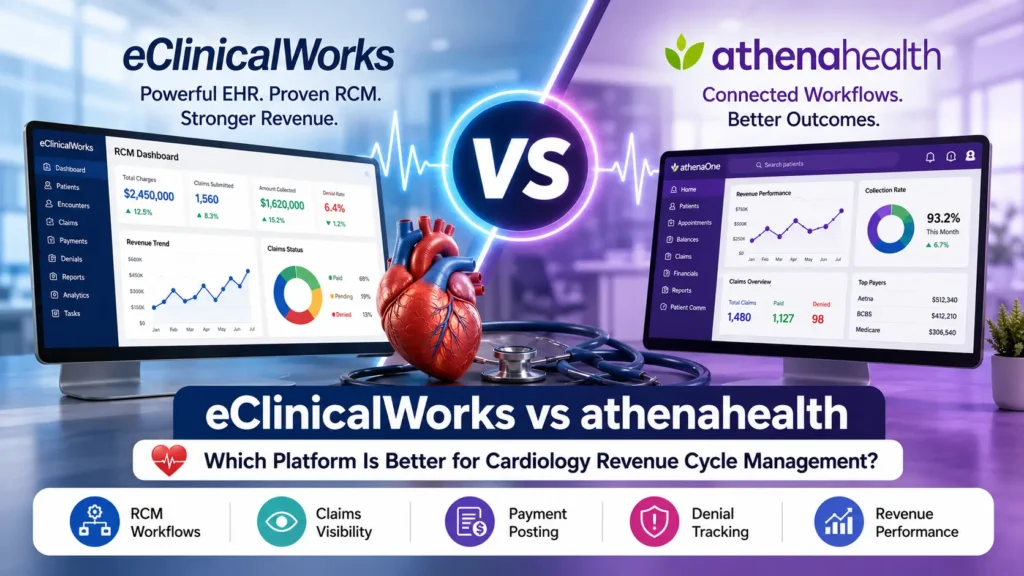
eClinicalWorks vs athenahealth for Cardiology Revenue Cycle Management
Choosing the right revenue cycle management platform is important for cardiology practices because billing is not limited to simple claim submission. Cardiology revenue cycle management often includes eligibility verification, prior authorization, charge capture, cardiology coding, claim submission, payment posting, denial management, A/R follow up, and financial reporting.
eClinicalWorks and athenahealth are two well known healthcare technology platforms that cardiology practices may compare. Both can support practice workflows, billing operations, and revenue cycle visibility, but they are not the same. The right choice depends on your practice size, billing team, workflow complexity, reporting needs, and how much revenue cycle support your team requires.
This blog compares eClinicalWorks vs athenahealth for cardiology revenue cycle management so cardiology practices can better understand which platform may fit their billing workflow and financial goals.
Why Cardiology Revenue Cycle Management Matters
Cardiology billing can be complex because practices often manage office visits, EKGs, echocardiograms, stress tests, cardiac monitoring, diagnostic testing, imaging related coordination, and follow up care. Each service must be supported by accurate documentation, correct CPT and ICD 10 codes, payer specific rules, modifiers, and timely claim submission.
A strong cardiology revenue cycle management process helps practices track claims from the first patient interaction to final payment. This includes checking coverage, confirming authorization, capturing charges correctly, submitting clean claims, posting payments, following up on denials, and monitoring unpaid balances.
The right RCM platform can improve visibility, reduce manual work, and help teams identify where payments are delayed. However, software works best when it is supported by trained billing professionals who understand cardiology workflows.
eClinicalWorks for Cardiology RCM
eClinicalWorks is a cloud based healthcare technology platform used by many ambulatory practices. It offers EHR software, patient engagement tools, telehealth solutions, population health tools, and revenue cycle management support.
For cardiology revenue cycle management, eClinicalWorks may be useful for practices that want clinical documentation, patient information, billing operations, and reporting tools connected in one platform. It can help practices manage workflows more efficiently and improve visibility into billing performance.
eClinicalWorks may be a good fit for cardiology practices that want a broad EHR and RCM system with automation, patient engagement, and reporting capabilities. It can support practices that want to streamline billing operations and improve access to financial data.
eClinicalWorks may be better if your practice wants
athenahealth for Cardiology RCM
athenahealth offers athenaOne, which combines EHR, revenue cycle management, medical billing, practice management, patient engagement, and workflow tools. athenahealth also positions its practice management and medical billing solution around helping practices submit cleaner claims, reduce manual work, and collect payments more efficiently.
For cardiology practices, athenahealth may be useful when the team wants a connected platform with RCM services and billing workflow support. It can help practices manage claim activity, billing tasks, patient engagement, collections, and reporting in one system.
athenahealth may be a good fit for cardiology practices that want software plus additional billing workflow support. It may be especially helpful for practices that want to reduce manual administrative work and improve revenue cycle visibility.
athenahealth may be better if your practice wants:
eClinicalWorks vs athenahealth Comparison
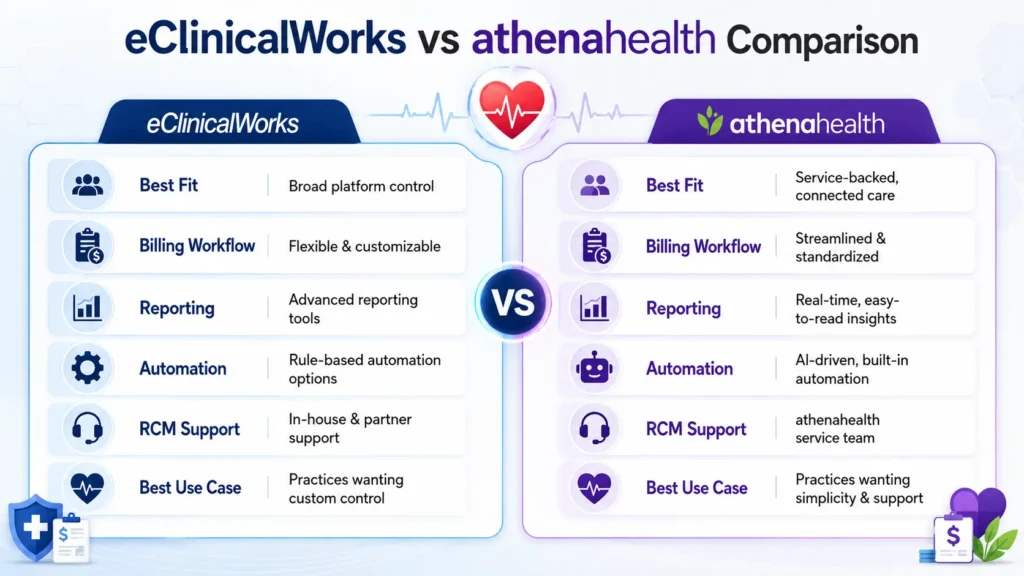
When comparing eClinicalWorks vs athenahealth for cardiology revenue cycle management, the main difference comes down to workflow style, RCM support, automation, reporting, and how much billing help your practice needs. eClinicalWorks may work well for practices that want a broad cloud EHR and RCM platform with strong operational tools. athenahealth may fit practices that want connected workflows with billing services and revenue cycle support.
eClinicalWorks can be useful for cardiology practices that want to connect clinical documentation, patient engagement, and billing operations. It may be a good choice when a practice wants visibility into billing workflows while keeping strong internal control over daily processes.
athenahealth may be useful for cardiology practices that want support across claims, billing, patient collections, and revenue cycle workflows. It may fit practices that want to reduce manual work and use a platform with RCM services built into the workflow.
Before choosing a platform, cardiology practices should compare how each system supports eligibility, authorization, claim submission, denial tracking, payment posting, A/R follow up, reporting, and cardiology billing and coding workflows.
Feature Area |
eClinicalWorks |
athenahealth |
|---|---|---|
|
Best Fit |
Practices wanting broad EHR, RCM, and operational tools |
Practices wanting connected EHR, billing, and RCM services |
|
Platform Type |
Cloud EHR with patient engagement, telehealth, and RCM support |
Integrated EHR, practice management, billing, and patient engagement platform |
|
Billing Workflow |
Supports billing operations and financial visibility |
Supports claims, billing workflows, collections, and RCM visibility |
|
Cardiology Specialty Fit |
Useful for practices needing connected clinical and billing workflows |
Useful for practices needing billing service support and workflow visibility |
|
Reporting |
Helpful for billing performance and operational reporting |
Helpful for revenue cycle, collections, and workflow reporting |
|
Staff Requirement |
Works best with trained billing staff and strong internal workflows |
May reduce some manual billing pressure with service backed workflows |
|
RCM Support |
Can help streamline billing operations and reporting |
Can support claims, denials, collections, and billing workflow management |
|
Best Use Case |
Practices wanting broad platform control |
Practices wanting software plus revenue cycle support |
Which Platform Is Better for Cardiology Practices?
There is no single best option for every cardiology practice. The right platform depends on your team, practice size, billing complexity, budget, and revenue cycle goals.
Choose eClinicalWorks if your cardiology practice wants a broad EHR and RCM platform that connects clinical documentation, patient engagement, telehealth, billing operations, and reporting.
Choose athenahealth if your cardiology practice wants an integrated platform with billing workflow support, revenue cycle services, patient engagement, and tools that may help reduce manual billing work.
Why RCM Software Alone Is Not Enough
eClinicalWorks and athenahealth can both support cardiology revenue cycle management, but software alone cannot guarantee clean claims, accurate coding, or faster reimbursement. Cardiology billing still needs human review and specialty knowledge.
Cardiology practices need accurate documentation, CPT and ICD 10 coding review, prior authorization tracking, claim scrubbing, payment posting, denial management, payer communication, and A/R follow up. If the billing team does not understand cardiology payer rules, even a strong software platform may still lead to denials, underpayments, and delayed payments.
This is why many cardiology practices use RCM software along with professional cardiology medical billing services.
How Capital Med Solutions Can Help
Capital Med Solutions helps cardiology practices manage billing workflows with accuracy, consistency, and specialty focused support. Whether your practice uses eClinicalWorks, athenahealth, or another billing platform, our
can help improve claim accuracy, strengthen revenue cycle performance, and reduce billing workload for your team.
Our cardiology billing support may include:
With the right billing support, cardiology practices can use their RCM software more effectively and keep the revenue cycle moving with fewer workflow gaps.
Final Thoughts
eClinicalWorks and athenahealth can both support cardiology revenue cycle management, but they fit different practice needs. eClinicalWorks may be better for practices that want a broad cloud EHR and RCM platform with strong operational control. athenahealth may be better for practices that want integrated software with billing workflow and revenue cycle support.
The best choice depends on your cardiology practice’s size, billing team, workflow complexity, and financial goals. No matter which platform you choose, accurate cardiology billing and coding remain essential for clean claims, fewer delays, and stronger reimbursement performance.
If your cardiology practice needs help with billing software workflows, claims, denials, payment posting, or A/R follow up, Capital Med Solutions can support your team with reliable cardiology medical billing services.
Need Help With Cardiology Revenue Cycle Management?
Capital Med Solutions helps cardiology practices manage coding, claims, denials, payment posting, and A/R follow up with reliable billing support.