Common Orthopedic Billing Errors and How to Avoid Them
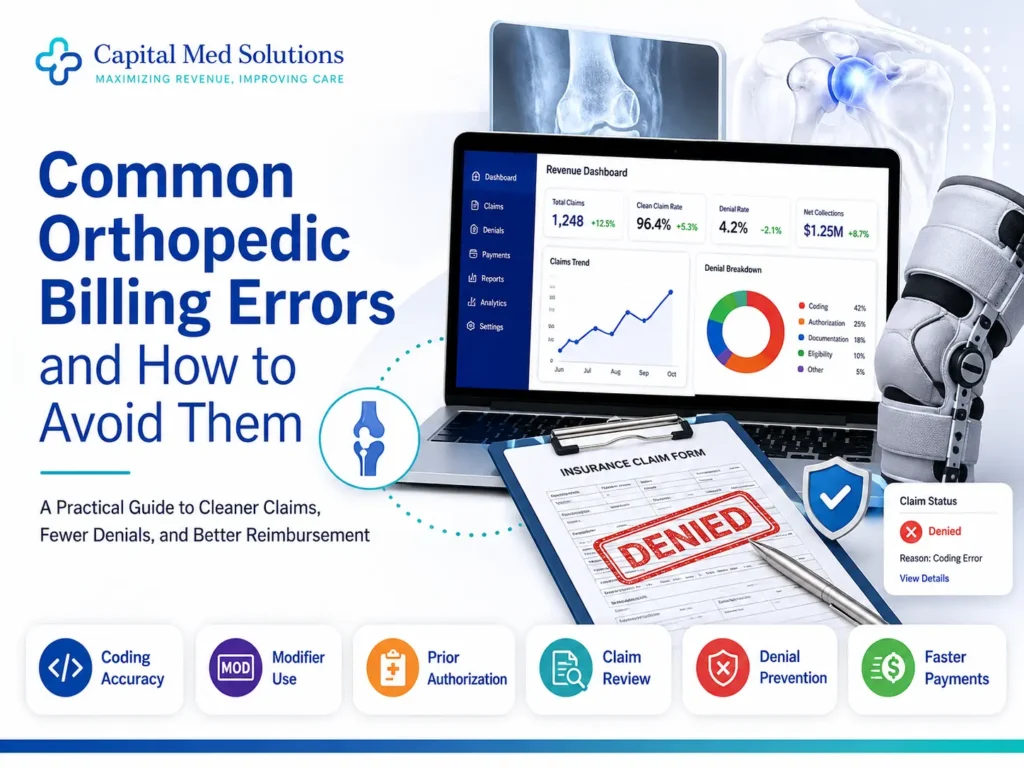
Orthopedic billing involves far more than entering a procedure code and submitting a claim. A single encounter may include an office evaluation, diagnostic imaging, an injection, durable medical equipment, fracture care, or surgery. Each service must be supported by the medical record and reported according to the patient’s condition, treatment location, payer requirements, and applicable coding rules.
Small mistakes can have significant consequences. Missing laterality, an unsupported modifier, an incomplete operative note, or an overlooked authorization requirement may result in a denial, reduced reimbursement, delayed payment, or a request for additional documentation.
This guide examines the most common orthopedic billing errors, explains why they occur, and provides practical ways to prevent them throughout the revenue cycle.
Why Orthopedic Practices Need Accurate Billing
Orthopedic practices manage a wide range of conditions and procedures, from sprains and fractures to joint injections, arthroscopy, spinal treatment, and total joint replacement. This clinical variety makes orthopedic medical billing especially dependent on detailed documentation and precise code selection.
The billing team must determine exactly what was treated, which body part was involved, whether the service was unilateral or bilateral, and whether multiple procedures were distinct or part of one bundled service. The team may also need to account for global surgical periods, prior authorization, implant documentation, therapy limits, and durable medical equipment requirements.
The financial risk is substantial when these details are missing. CMS reported a 43.6% improper payment rate for major hip and knee replacement or lower-extremity reattachment in its 2024 Medicare data. Medical necessity was the leading reason, followed by insufficient or missing documentation and incorrect coding.
Coding and Documentation Errors
Many orthopedic claim problems begin before the claim reaches the clearinghouse. They start when the clinical documentation does not clearly support the diagnosis, service, anatomical location, or level of care being billed.
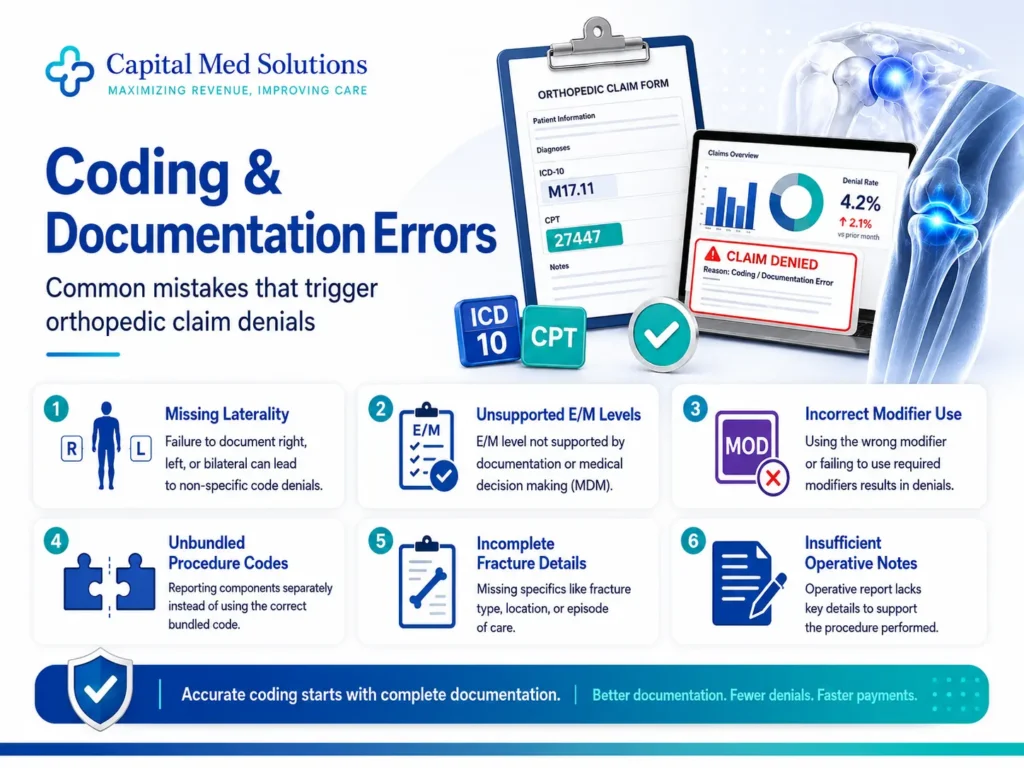
One common mistake is choosing a general diagnosis when the record supports a more specific code. Orthopedic diagnosis coding may require details such as the injured structure, right or left side, type of fracture, encounter stage, healing status, or whether a condition is traumatic or degenerative. When these details are missing, the coder may be unable to select the most accurate code.
Modifier errors are another frequent concern. Modifier 25 should only be attached to an evaluation and management service when the provider performs a significant, separately identifiable E/M service on the same day as another procedure. A routine assessment already included in the procedure should not automatically be billed separately.
Warning Signs of Coding and Documentation Problems
Orthopedic practices should investigate their workflow when they regularly encounter:
CMS permits certain anatomical, global-surgery, and distinct-service modifiers to bypass NCCI edits only when the clinical circumstances justify their use. These include LT, RT, modifier 59, and the more specific XE, XS, XP, and XU modifiers.
Claim Submission and Follow-Up Errors
A claim may be correctly coded and still fail because of an administrative mistake. Eligibility changes, missing referrals, expired authorizations, incorrect provider information, and payer-specific filing rules can interrupt reimbursement even when the service was medically necessary.
Prior authorization is especially important for certain orthopedic and spine services. Depending on the payer, setting, procedure, and plan, authorization may be required before surgery, advanced imaging, injections, orthotics, or other services. Medicare also maintains prior-authorization programs for selected hospital outpatient procedures, including certain cervical fusion and facet-joint services.
Poor denial follow-up creates a second layer of revenue loss. When denied claims are placed in a general work queue without being categorized, assigned, or tracked against appeal deadlines, staff may repeatedly correct the same issue without addressing its source.
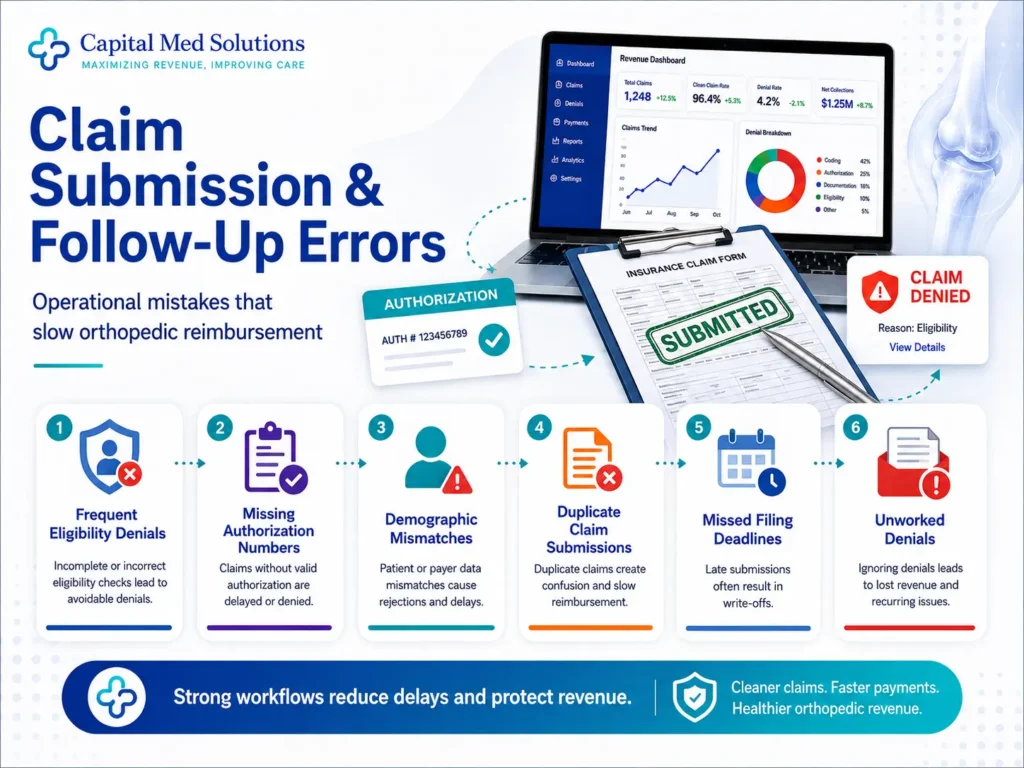
Warning Signs of Revenue-Cycle Problems
Operational weaknesses may be present when a practice experiences:
Orthopedic practices that dispense braces, supports, or other covered equipment must also follow applicable order and documentation requirements. CMS states that the treating practitioner must provide a complete written order to the supplier before a Medicare DMEPOS claim is submitted.
Orthopedic Billing Error Comparison
Coding and documentation errors differ from claim-processing errors, but the two categories often overlap. A missing detail in the medical record may lead to the wrong code, while an otherwise correct code may still be denied because authorization was not obtained.
Coding problems usually require a review of the clinical note, current code sets, NCCI edits, or payer policy. Administrative problems generally require verification of registration information, coverage, referrals, authorization records, claim status, or filing requirements.
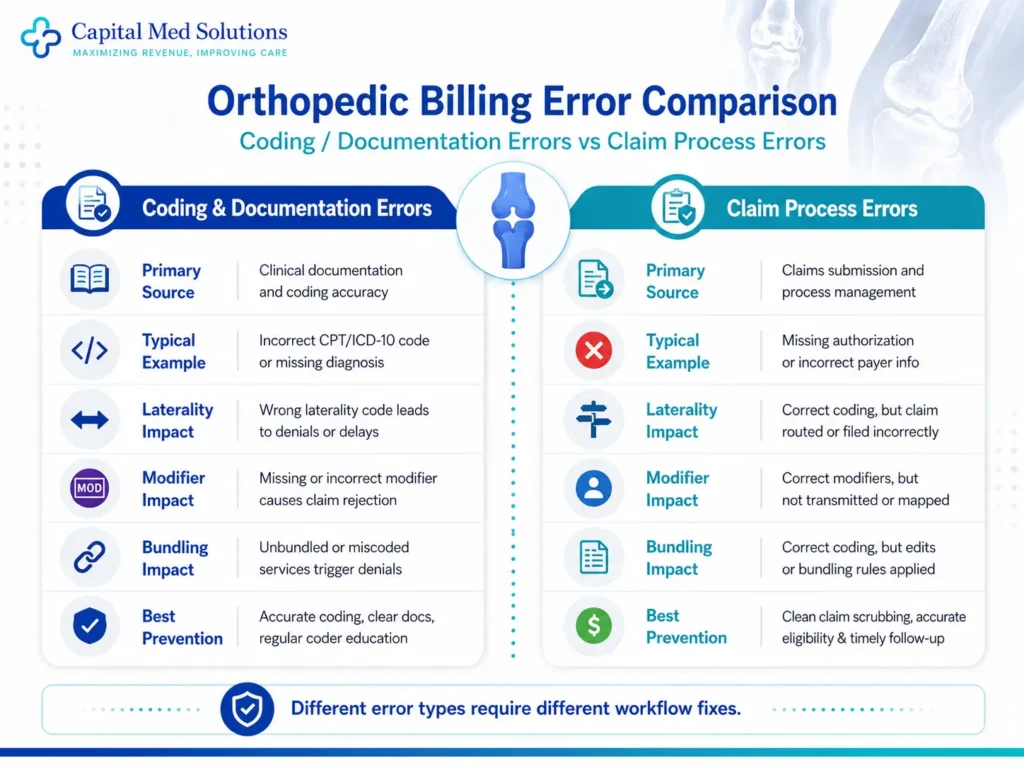
The best prevention strategy is therefore not limited to the billing department. Providers, front-desk employees, surgery schedulers, coders, billers, and accounts-receivable staff must share clear responsibilities.
Practices should also review current coding resources rather than relying on old software edits or internal cheat sheets. CMS updates the Medicare NCCI Policy Manual annually and publishes procedure-to-procedure edit changes quarterly.
A structured comparison can help managers identify where additional training or workflow controls are needed.
Error Area |
Coding or Documentation Error |
Claim-Process Error |
|
Primary source |
Clinical note or code selection |
Registration, authorization, submission, or follow-up |
|
Typical example |
Wrong fracture code |
Missing authorization number |
|
Laterality impact |
LT, RT, or bilateral detail omitted |
Correct modifier lost during claim entry |
|
Modifier impact |
Modifier used without clinical support |
Valid modifier omitted from the submitted claim |
|
Bundling impact |
Separately reporting bundled services |
Claim scrubber fails to identify an edit |
|
Surgical impact |
Global-period service coded incorrectly |
Postoperative claim routed to the wrong payer |
|
Best prevention |
Provider education and coding review |
Eligibility checks and submission controls |
|
Main correction method |
Amend documentation or correct coding |
Correct, resubmit, appeal, or contact the payer |
Which Errors Create the Greatest Revenue Risk?
The most damaging orthopedic billing errors are not always the ones with the highest individual dollar value. Repeated errors affecting routine office visits, imaging, injections, or equipment can gradually create a large accounts-receivable balance.
High-value procedures deserve additional attention because one mistake may affect a substantial payment. Joint replacements, spine procedures, fracture care, and surgeries involving implants should undergo documentation and authorization checks before claim submission. The diagnosis, treatment history, medical necessity, procedure details, and place of service must tell a consistent story.
Practices should prioritize errors according to frequency, financial impact, appeal success, and preventability. A denial dashboard can reveal whether the main problem is documentation, coding, registration, authorization, payer processing, or untimely follow-up.
Why Billing Software Alone Is Not Enough
Billing software can identify missing fields, invalid code combinations, or basic eligibility problems. It can also automate claim creation, remittance posting, work queues, and reports. However, software cannot determine whether a surgeon’s documentation fully supports the service unless the correct clinical information has been entered.
Automated edits also need ongoing maintenance. A rule that was accurate last year may not reflect current CPT guidance, NCCI updates, payer policies, or authorization requirements. Relying on outdated edits may allow incorrect claims to pass through or stop valid claims unnecessarily.
Technology works best when combined with trained staff, provider communication, internal audits, and payer-specific processes. Human review remains particularly important for modifier use, global surgery, medical necessity, complex operative reports, and denial appeals. CMS’s global surgery guidance explains that services performed during a surgical package may be included or separately reportable depending on the circumstances and applicable modifiers.
How a Specialized Billing Partner Can Help
A specialized orthopedic billing partner can review the complete revenue cycle instead of correcting individual claims after they are denied. The goal should be to identify where errors begin and establish controls that prevent them from recurring.
Support may include reviewing documentation quality, claim edits, payer requirements, authorization workflows, denial trends, and accounts-receivable performance.

A billing partner can assist with:
The practice should receive more than a list of unpaid claims. Useful reporting should explain why claims are delayed, which services are affected, what corrective action is required, and how the same issue can be prevented.
Final Thoughts
Common orthopedic billing errors usually result from incomplete documentation, incorrect code selection, unsupported modifiers, missed authorization requirements, or inconsistent claim follow-up. Because orthopedic care involves many anatomical sites, procedures, and treatment settings, even a small omission can change how a service should be reported.
Prevention begins with clear documentation standards, accurate patient registration, current coding resources, payer-specific verification, and defined responsibilities across the practice. Regular denial analysis can then show whether these controls are working.
A proactive orthopedic billing process does more than reduce denials. It improves payment consistency, protects staff time, supports compliance, and gives practice leaders a clearer view of their financial performance.
Need Help Reducing Orthopedic Billing Errors?
Strengthen your orthopedic revenue cycle with accurate coding reviews, cleaner claims, organized denial follow-up, and billing support designed around your practice’s workflow.